UNESCO on the Ground by Michael Dylan Foster Lisa Gilman & Lisa Gilman
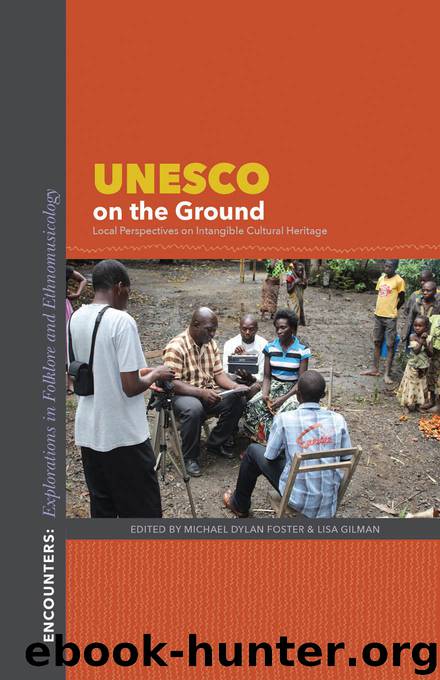
Author:Michael Dylan Foster,Lisa Gilman & Lisa Gilman
Language: eng
Format: epub
Publisher: Indiana University Press
Published: 2015-03-01T16:00:00+00:00
Notes
1. All population statistics are from December 1, 2014 (Satsumasendai-shi, http://www.city.satsumasendai.lg.jp/www/contents/1300087101977/index.html).
2. I have been researching Toshidon since 1999 and have observed the ritual in 1999, 2000, 2009, 2011, 2012, and 2013. I have also conducted fieldwork on the island at other times of the year and was in fulltime residence from December 2011 to May 2012; I am grateful for the generous support of a Fulbright Fellowship that funded my research during that period. My descriptions here are based primarily on the ritual as performed in the neighborhoods of Fumoto and Motomachi and on numerous formal and informal interviews with island residents as well as visitors. I am profoundly grateful to my friends in these communities for generously putting up with me, and my questions, for so many years. For a more detailed discussion of the ritual and its touristic context, see Foster 2011 and 2013. See also Tsuchiya 2014a and 2014b. Please note: throughout this essay Japanese proper names are written in Japanese order, with family name first. All translations from Japanese, whether oral or written, are my own.
3. In the Ryūkyū island area in the south of Japan, similar observances take place during late summer.
4. Interview with island resident (O. Y.) conducted in January 2000.
5. The suffix -sama is an honorific attached to names and titles of people and gods to show respect. It is commonly used by islanders when speaking of Toshidon.
6. As of June 2015, there were 290 designated important intangible folk cultural properties in Japan, including 7 from Kagoshima Prefecture. See http://kunishitei.bunka.go.jp/bsys/categorylist.asp. For more on intangible cultural properties and preservation law in Japan, see Ōshima 2007; Thornbury 1993, 1994, 1995, 1997, 55–74; Hashimoto 1998, 2003; Cang 2007; and Aikawa-Faure 2014. Japanese cultural properties policies influenced the development of UNESCO’s ICH conceptions and programs (Kurin 2004, 67–68). Moreover the Masterpieces Program and the 2003 ICH Convention were both formalized by UNESCO while Kōichirō Matsuura, a Japanese diplomat, was serving as Director-General.
7. The elements added in 2009 are Akiu no Taue Odori; Chakkirako; Daimokutate; Dainichido Bugaku; Gagaku; Hayachine Kagura; Hitachi Furyumono; Koshikijima no Toshidon; Ojiya-chijimi, Echigo-jofu; Oku-noto no Aenokoto; Sekishu-Banshi; Traditional Ainu Dance; and Yamahoko, the float ceremony of the Kyoto Gion festival. (I render them here the way they are translated and transliterated in the UNESCO list itself; see http://www.unesco.org/culture/ich/index.php?pg=00011).
8. This seems to be a fairly accurate characterization of the process at the time. More recently, however, the Agency for Cultural Affairs has started to exercise greater selectivity in its nomination process.
9. There is some dispute as to how many people actually attended the lecture; some people claim there were no more than one hundred attendees while other say there were almost two hundred. Either number attests to significant interest.
10. For more on the visual documentation of tradition in Japan, see Hyōki Satoru 2007.
11. For more on the reasons for these distinctions, see Foster 2011.
12. In May 2012, I attended a joint meeting of the Toshidon Preservation Societies in which members chose to deny a request made by a local television station to broadcast the DVD publically.
Download
This site does not store any files on its server. We only index and link to content provided by other sites. Please contact the content providers to delete copyright contents if any and email us, we'll remove relevant links or contents immediately.
| Anthropology | Archaeology |
| Philosophy | Politics & Government |
| Social Sciences | Sociology |
| Women's Studies |
Born to Run: by Christopher McDougall(7127)
The Leavers by Lisa Ko(6948)
iGen by Jean M. Twenge(5416)
Sapiens by Yuval Noah Harari(5372)
Spare by Prince Harry The Duke of Sussex(5197)
The Kite Runner by Khaled Hosseini(5180)
Machine Learning at Scale with H2O by Gregory Keys | David Whiting(4313)
Bullshit Jobs by David Graeber(4190)
Never by Ken Follett(3957)
Goodbye Paradise(3810)
Livewired by David Eagleman(3775)
Fairy Tale by Stephen King(3399)
A Dictionary of Sociology by Unknown(3085)
Harry Potter 4 - Harry Potter and The Goblet of Fire by J.K.Rowling(3074)
The Social Psychology of Inequality by Unknown(3031)
The Club by A.L. Brooks(2926)
Will by Will Smith(2920)
0041152001443424520 .pdf by Unknown(2846)
People of the Earth: An Introduction to World Prehistory by Dr. Brian Fagan & Nadia Durrani(2738)
